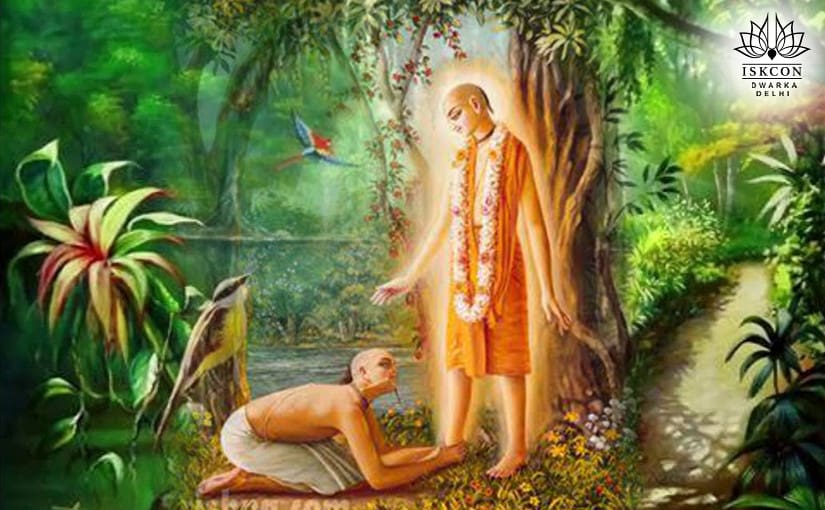
Every year on the full moon of Asadh, we remember Srila Sanatana Goswami at ISKCON Dwarka. He is one of the most respected teachers in the Gaudiya Vaishnava tradition, and his life still raises a question many of us quietly sit with. How do you stay devoted when comfort keeps calling you back?
Sanatana Goswami had power, wealth and a secure future. He walked away from all of it, not out of frustration, but because he found something that mattered more.
Born Into Scholarship
Sanatana Goswami was born in 1488 into a family of brahmana scholars known for their command over the Vedas. His father moved the family so his sons could study under respected teachers of philosophy and rhetoric, and Sanatana grew up alongside his brothers Rupa and Vallabha, who would later become known as Rupa Goswami and Anupama.
Even as young scholars, the brothers showed signs of where their hearts truly were:
- They planted tulsi, tamal and kadamba trees near their home in memory of Krishna’s pastimes
- They built small replicas of Radha Kunda and Shyama Kunda long before ever seeing the originals
- They studied scripture with an intensity that went beyond what their teachers expected
Their brilliance eventually reached the ruler Hussain Shah, who appointed Sanatana and Rupa as ministers. Sanatana was given the title Sakara Mallik. He now had authority, wealth and every reason to stay exactly where he was. Scholars and pandits from far-off lands would often stay as guests in his home, drawn by the reputation the two brothers had built together.
The Meeting That Changed Everything
Despite his position, Sanatana Goswami had been longing for the darshan of Chaitanya Mahaprabhu. When they finally met, something settled in him that his career never could. He resigned from his post soon after.
The Sultan refused to accept it. Sanatana was imprisoned for stepping away from his duties, but his brother Rupa had already arranged funds for exactly this kind of situation. With that help, Sanatana escaped and set out to meet Chaitanya Mahaprabhu.
What stands out in this part of his story is restraint, not rebellion. Sanatana Goswami did not walk away from his responsibilities on impulse. He held on until his position and his purpose could no longer sit together, and only then did he choose with full conviction.
Choosing a Life of Simplicity

Sanatana Goswami eventually settled in Vrindavan and lived with almost nothing. He lived in a small hut, walking to nearby villages to beg for flour, and got by on nothing but plain chapatis. It was during this time that Krishna is said to have appeared before him as a cowherd boy named Madana Gopal, asking to stay with him.
A merchant named Krishna Dasa Kapoor later helped establish worship for this deity, who came to be known as Madana Mohan. That deity is still worshipped in Karauli today.
His daily life during these years followed a few quiet disciplines:
- He completed a long parikrama around a sacred hill regularly, even as age made it physically demanding
- He spoke with local villagers about their families, their harvests and their cattle, treating them as his own
- He spent long hours writing and studying scripture, often at the cost of his own comfort
- He accepted whatever came through begging without complaint
None of this was built for recognition. It was built on consistency, and that consistency is exactly what makes his example worth returning to today.
Writing for Generations That Would Follow
Chaitanya Mahaprabhu had asked Sanatana Goswami to document the philosophy of bhakti so that future devotees would have something reliable to stand on. He completed this task while living in genuine poverty.
| Text | What It Covers |
| Brihad Bhagavatamrita | The glories and nature of the Lord’s devotees |
| Hari Bhakti Vilasa | Rules and conduct for devotional practice |
| Krishna Lila Stava | Descriptions of Krishna’s pastimes |
| Brihad Vaishnava Toshani | Commentary meant to bring joy to devotees |
These texts were written without the comfort of financial security or an easy household. Sanatana Goswami chose scholarship and service over the life he had already tasted as a minister, and that choice shaped the tradition that followed him.
What This Teaches Us Today
Most of us are not being asked to give up ministerial posts or royal wealth. But many of us in Delhi live with cluttered schedules and very little space to think clearly. Sanatana Goswami’s life suggests that clarity does not need a dramatic exit. It needs honesty about what actually matters and the willingness to simplify around it, one choice at a time.
His disappearance day often arrives with the season’s first heavy rain, and devotees find that timing fitting. Just as rain clears the air, this day is meant to clear away distraction and bring focus back to what is essential. It is less about looking back at history and more about asking what deserves your attention right now.
A few simple ways to sit with his example:
- Read from the Bhagavatam, the scripture he considered his closest companion
- Take a few quiet minutes to notice where your own priorities have grown scattered
- Speak with someone about a devotional text instead of scrolling past it
How We Observe This Day at ISKCON Dwarka
We mark Sanatana Goswami’s disappearance day through kirtan and reflection on his life and his writings. You are welcome to join us, wherever you are travelling from.
Sanatana Goswami’s life was never about renunciation for its own sake. It was about choosing what truly mattered and staying with that choice, even when the world kept offering easier paths.
Visit ISKCON Dwarka this Asadh Purnima and join us in our remembrance of Srila Sanatana Goswami. Sanatana Goswami ki Jai.