The monsoon has a way of slowing everyone down, and the full-moon night of Ashadha, which falls right in the middle of it, carries a similar quietness. This is Guru Purnima, a day set aside for something we rarely make time for: sitting still and being genuinely thankful to the person who taught us how to see clearly.
At ISKCON Dwarka, this day is dedicated to Shrila Vyasadeva, the sage who gave the world the Vedas, the Mahabharata, and the Puranas. That is why it is also known as Vyasa Purnima. His story is really the best starting point for understanding why this festival still holds so much meaning today.
Who Was Shrila Vyasadeva?
Vyasadeva was born to the sage Parashara Muni and Satyavati, a fisherman’s daughter. As a child, he was called Krishna because of his dark complexion, and later Dwaipayana, since he was born on an island. Once he divided the Vedas into a form people could actually study, he came to be known as Veda Vyasa, meaning one who expands and explains knowledge in detail.
What he gave the world:
- Divided the single Veda into four parts so people could study them more easily
- Compiled the Puranas to preserve authentic history and teaching through stories
- Wrote the Mahabharata so even those without formal scriptural training could find the path to dharma
It was one of the most generous acts of knowledge sharing in our tradition, and it is worth remembering that it all came from one man’s effort to make wisdom accessible to everyone, not just scholars. Before this, the depth of Vedic knowledge was largely out of reach for ordinary people, passed down in forms that demanded years of specialised training. Vyasadeva changed that, and scholars and teachers still rely on his work today.

The Restlessness Behind the Shrimad Bhagavatam
Here is the part of the story people often miss. After giving humanity the Vedas, the Puranas, and the Mahabharata, Vyasadeva still felt something was missing. He had organised everything correctly, yet his heart was not at peace.
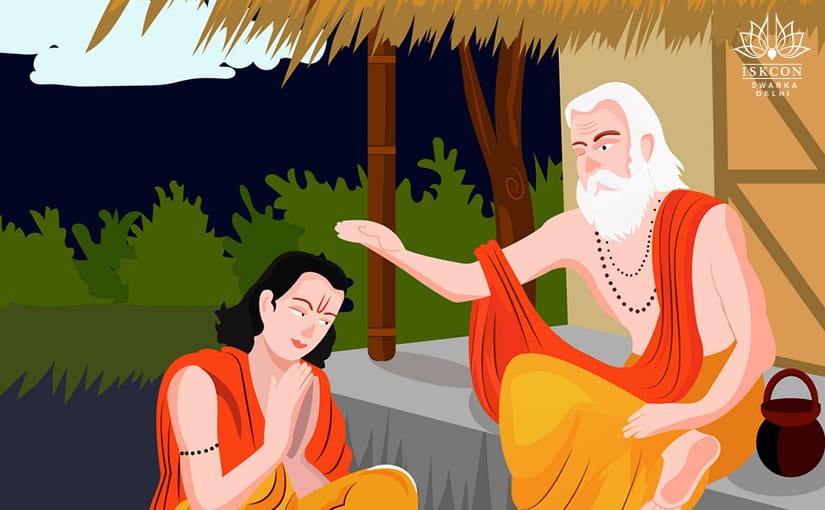
His own guru, Narada Muni, visited him by the Sarasvati river and pointed out the gap. All this work had guided people toward rightful action, but had not placed enough emphasis on pure devotion to God. Taking that guidance to heart, Vyasadeva went on to write the Shrimad Bhagavatam, now regarded as the ripened fruit of Vedic knowledge.
Even the compiler of the Vedas needed his own guru to show him what was missing. That, in many ways, is the entire point of Guru Purnima.
Why the Guru Holds Such a High Place
There is a Sanskrit root worth knowing here. Gu means darkness, and Ru means the one who removes it. A guru’s role, quite literally, is to take away the darkness of ignorance and replace it with clarity.
This is why devotees recite this verse on Guru Purnima:
Guru Brahma, Gurur Vishnu, Gurur Devo Maheshwara; Guru Sakshat Param Brahma: Tasmai Shri Guruvey Namah.
The guru serves as creator, sustainer, and guide and is owed complete respect and surrender. This is also why the guru-disciple relationship is treated as sacred rather than casual. A guru does not simply hand over information the way a textbook does. A true guru lives what they teach, and a disciple’s growth depends on how honestly they absorb that example.
How Guru Purnima Is Observed
The practices around this day are simple, but they carry weight when done with sincerity:
- Worship and gratitude, offered directly to one’s guru or through prayer and remembrance
- Fasting, often kept light, avoiding grains and salt, as a prayer for the guru’s continued guidance
- Honest reflection on the teachings received through the year, and whether they have actually been practised
- Chanting and remembrance of the guru’s teachings and the glories of the Supreme Lord
- Studying scripture is considered one of the truest ways to honour a teacher
What matters here is sincerity, not scale. A quiet, honest effort counts for far more than an elaborate ritual done without thought.
What This Day Means at ISKCON Dwarka
- We treat Guru Purnima as one of the most important days on our temple calendar, and every year we open our doors to devotees who want to mark it properly.
- If you already have a spiritual guide, this is your day to express that gratitude in person, through prayer, worship, and quiet reflection on what you have learned.
- If you do not yet have one, it is still a meaningful day to sit in the association of devotees and understand what real guidance looks like.
- Families often bring their children along, and that matters more than it might seem. Respect for a teacher is not something you can explain in a sentence. It has to be felt, usually by watching it happen around you. For many people, this is also the one day of the year they consciously think about who has shaped their understanding of life, whether that is a formal spiritual guide or simply someone whose example they have quietly followed.
A Quick Look at the Essentials
| What | Details |
| Also called | Vyasa Purnima |
| Falls on | The full moon of Ashadha, during the monsoon |
| Honours | Shrila Vyasadeva, compiler of the Vedas |
| Core practice | Worshipping and expressing gratitude to one’s guru |
| Common observance | A light diet, often avoiding grains and salt |
| Underlying idea | The guru removes darkness and leads one toward God |
Join Us This Guru Purnima
Guru Purnima does not ask for anything elaborate. A sincere prayer, a moment of real reflection, and honest gratitude are enough to honour what this day stands for. We would love to have you at ISKCON Dwarka this year, whether you have been coming for a while or will be visiting for the first time. Sit with us, take part in the evening prayers, and give yourself the space this day is meant for.